

Reduction Of Nitrile With Lialh4
Nitriles can be reduced to primary amines when treated with LiAlH4 or to aldehydes when a milder reducing agent such as DIBAL is used.
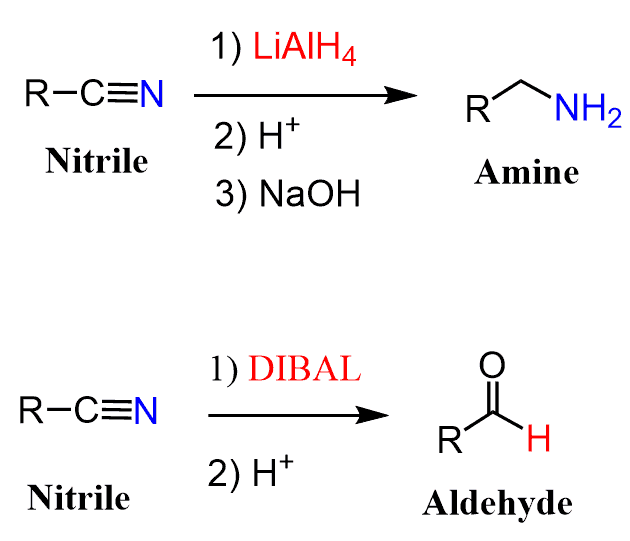
Just like any other reduction reaction, an acidic or aqueous workup is needed to get rid of the ionic intermediates. If the terminal production of the reaction is an amine, then usually information technology is treated with a hydroxide to deprotonate and isolate it in a neutral amine form.
The Mechanism of Nitrile Reduction with LiAlHiv
The reaction starts with q nucleophilic addition of hydride ion. This forms an imine salt which undergoes some other nucleophilic addition by AlH3 producing a highly reactive derivative of an amine:

Both Due north-Al and N-Li bonds in this derivative are very polar and apace react with h2o forming the new N-H bonds of the primary amine:

Observe that the pointer starting from the North-Li bond indicates the electrons forming an N-H bail and non Li-H. The lithium is most ionic (positively charged) and reacts with the -OH forming LiOH. Likewise, in the second step of the workup, the arrow starting from the N-Al bond forms a new Northward-H bail and Al(OH)H2.
In summary, this is what we have as a plausible machinery for the reduction of nitriles to principal amines:

The Mechanism of Nitrile Reduction past DIBAL
DIBAL is a milder reducing amanuensis than LiAlH4 and it tin be used for selective reduction of esters and nitriles to aldehydes.
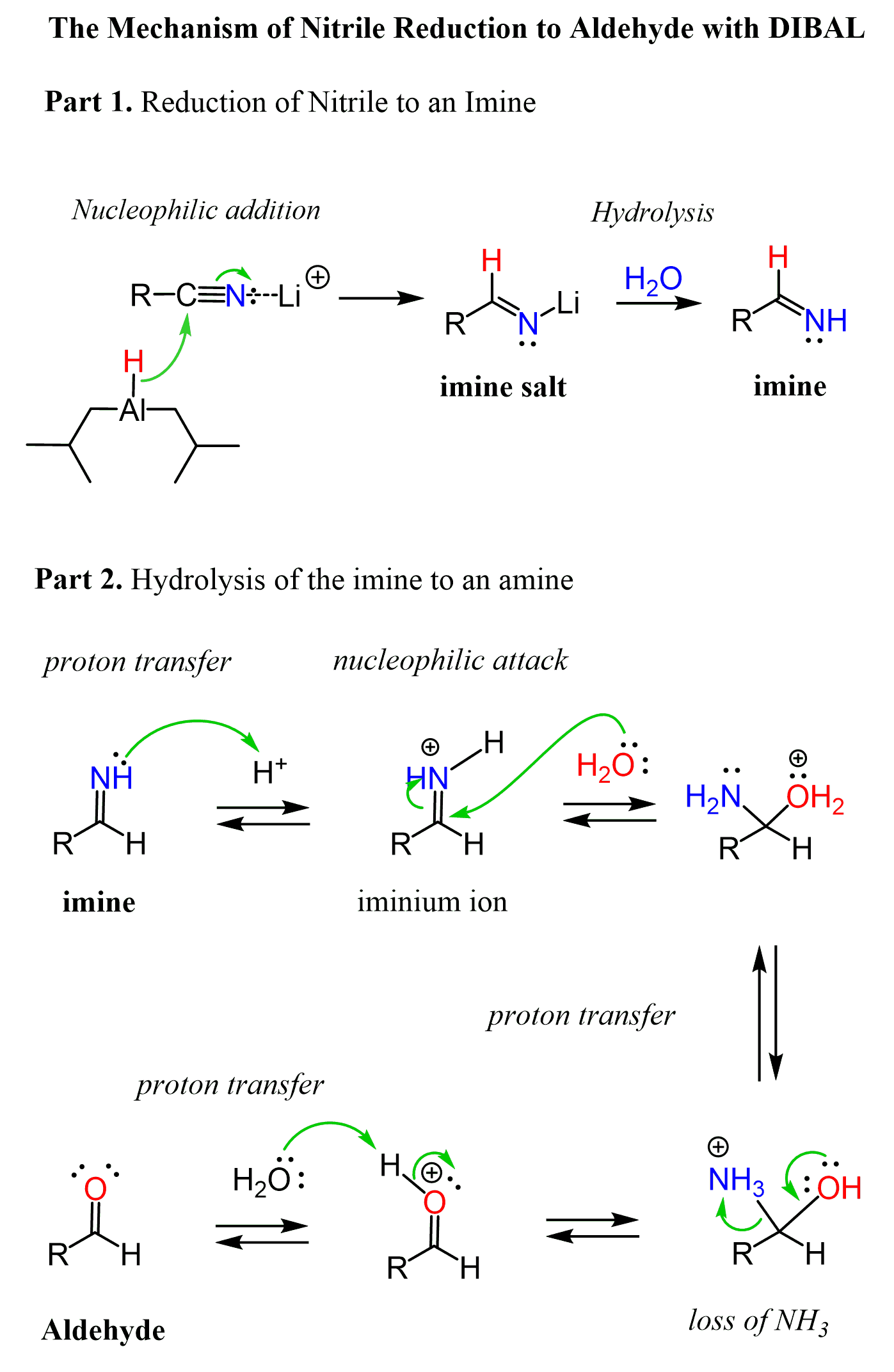
The reaction again starts with a hydride addition to the C-N triple bond forming an iminium anion. The difference between DIBAL and LiAlHiv is that DIBAL is not powerful plenty to perform another hydride addition to the negatively charged intermediate.

And this is the reward of DIBAL considering after the starting time hydride addition, we can quench the reaction by aqueous workup which hydrolyzes the imine to an aldehyde.
Combining these two parts, hither is what we have for the machinery of Nitrile reduction to an aldehyde past DIBAL:
More details well-nigh the hydrolysis of imines and enamines are covered here.
You may not need this in practise as an undergrad but let me mention that these reactions are nowhere virtually as smooth and platonic as they appear on paper. Very often, you may cease upwards reducing these derivatives to alcohols and oxidizing them to aldehydes since DIBAL volition practise a complete reduction similar LiAlH4 does.
Check Likewise
- Carboxylic Acids and Their Derivatives Practice Bug
- Preparation of Carboxylic Acids
- Fischer Esterification
- Ester Hydrolysis by Acid and Base-Catalyzed Hydrolysis
- What is Transesterification?
- Esters Reaction with Amines – The Aminolysis Machinery
- Ester Reactions Summary and Exercise Problems
- Preparation of Acyl (Acid) Chlorides (ROCl)
- Reactions of Acrid Chlorides (ROCl) with Nucleophiles
- Reaction of Acyl Chlorides with Grignard and Gilman (Organocuprate) Reagents
- Reduction of Acyl Chlorides by LiAlH4, NaBH4, and LiAl(OtBu)3H
- Preparation and Reaction Mechanism of Carboxylic Anhydrides
- Amides – Structure and Reactivity
- Amides Hydrolysis: Acrid and Base-Catalyzed Machinery
- Amide Dehydration Machinery by SOCl2, POCl3, and P2O5
- Amide Reduction Mechanism past LiAlH4
- Amides Preparation and Reactions Summary
- The Mechanism of Nitrile Hydrolysis To Carboxylic Acid
- Nitrile Reduction Mechanism with LiAlH4 and DIBAL to Amine or Aldehyde
- The Machinery of Grignard and Organolithium Reactions with Nitriles

Reduction Of Nitrile With Lialh4,
Source: https://www.chemistrysteps.com/nitrile-reduction-mechanism-with-lialh4-and-dibal-to-amine-or-aldehyde/
Posted by: laraobeft1996.blogspot.com
0 Response to "Reduction Of Nitrile With Lialh4"
Post a Comment