

Cl P Cl Bond Angle
CH3Cl Lewis Structure, Molecular Geometry, Bail angle and Hybridization
Chloromethane or Methyl chloride having a molecular formula of CH 3 Cl is an organic compound. It is an odorless and transparent gas that was initially used every bit a refrigerant. Afterwards information technology was institute that this gas is toxic and can damage the central nervous organization of humans. Although it is no longer used equally a refrigerant, Chloromethane has many uses and applications in several chemical and pharmaceutical industries.
To sympathize its chemical properties and physical properties, one needs get-go to know the Lewis construction and molecular geometry of CH 3 Cl. And to help you with understanding its construction in-depth, I will aid you to brand its Lewis construction step-past-pace in this blog post.
Simply before looking at that, permit us first discuss the valence electrons present in this compound as these electrons are the ones that form bonds.
CH3Cl Valence electrons
If yous have been studying chemistry for some time, and so you might be aware of the "octet rule." This rule states that atoms bond with each other atoms such that they have eight electrons in the concluding valence shell. This happens considering it tries to achieve the aforementioned valence electron configuration as inert gases. The atoms that have complete octets or rather suffice the octet dominion go inert and non-reactive. There are some exceptions to this octet rule, e.yard., Hydrogen.
These valence electrons are the ones that participate in the bail germination. And then allow united states accept a look at the total number of valence electrons for CH 3 Cl.
Full no of valence electrons of CH 3 Cl = Valence electrons of Carbon + Valence electrons of Hydrogen + Valence electrons of Chlorine
Valence electrons of Carbon: 4 electrons
Valence electrons of Hydrogen: 1 * 3 = three electrons ( equally there are three hydrogen atoms, we will consider valence electrons of all the Hydrogen atoms )
Valence electrons of Chlorine: 7 valence electrons
Total no of valence electrons of CH 3 Cl= four + 3 +7
=14
Chloromethane ( CH 3 Cl) has 14 valence electrons.
CH 3 Cl Lewis structure
Now that nosotros know the total number of valence electrons in CH iii Cl, we can at present draw a Lewis structure for the aforementioned. This structure helps understand the arrangement of valence electrons around the private atoms along with the bonds they form. In Lewis structure, we utilise dots to stand for electrons and lines to bear witness bonds formed between two atoms.
Here we have three types of atoms in CH iii Cl: Carbon, Hydrogen, and Chlorine. Out of all these atoms, Carbon is the least electronegative i, and hence we will identify it in the cardinal position. Chlorine is the about electronegative atom.
So place the Carbon atom in the center and draw four dots around it like this:
Now that we have placed the Carbon atom, permit's put other atoms. As there are 3 hydrogen atoms, we volition first put these atoms around the Carbon atom. Place 3 H atoms with ane dot around the fundamental atom.
Every bit we have already place carbon and Hydrogen atoms, nosotros just take to place a Chlorine atom in this structure. Identify it on the forth side of the Carbon atom similar this
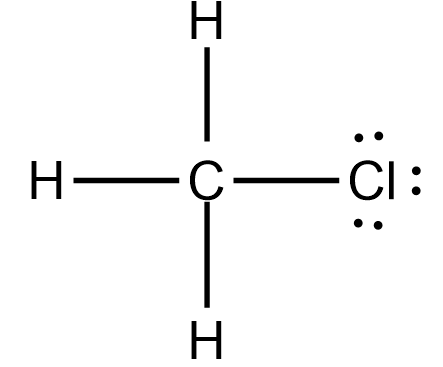
Now, if you run into closely, the Carbon atom is sharing four electrons with three hydrogen atoms and a Chlorine cantlet. As the Carbon atom needs 4 electrons to consummate its octet, all the valency is satisfied, and information technology now has 8 electrons in its valence shell.
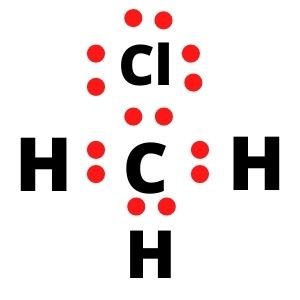
Similarly, each Hydrogen atom needs i electron, which they share with the central Carbon atom, and hence their outer shell is also completed. Due to their sharing of electrons, there is a single bond between C and H atoms.
In contrast, the Chlorine atom also completes its octet every bit information technology shares an electron with the Carbon atom. Carbon and Chlorine grade a unmarried bond as they share i electron to complete each other'due south octet. Hence all the valence electrons are used upwards, and there are iv unmarried bonds in the Lewis construction of CH 3 Cl.
CH iii Cl Hybridization
One can find the hybridization of any given molecule by using this simple formula:
Hybridization = No. of bonds + lone pairs at the central cantlet
= 4 + 0 ( in that location are no lonely pairs in CH 3 Cl as there is symmetric distribution of electrons)
=4
The carbon atom has an electronic configuration of 1s 2 2s 2 2p 2 in its footing state and has when it is in an excited state; the configuration is 1s ii 2s one 2p 3 . Hither the electrons shared by the Carbon lead to the formation of four hybridized orbitals, which include one southward-orbital and 3 p-orbitals. All the four electrons are arranged in these hybridized orbitals, making the hybridization of this molecule sp3.
CH 3 Cl Molecular Geometry
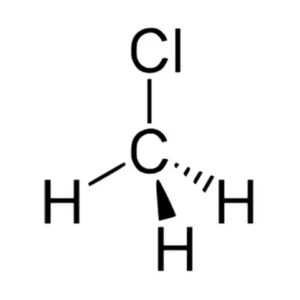
The molecular geometry of any given molecule is based on the number of atoms involved and the bonds formed in the structure. VSEPR theory or Valence electron shall pair repulsion theory is the concept nosotros use to determine the molecule'due south shape. This theory states that a molecule takes a shape in which 2 negatively charged centers are equally far from each other every bit possible ( both bonded and non-bonded pairs of electrons). The theory states that this happens to avoid repulsive forces. Co-ordinate to the VSEPR theory, molecules having a structure similar to AX4, where a molecule has 4 negatively charged centers, volition take a tetrahedral shape.
Besides, it has bond angles of 109.5, which corresponds to its molecular geometry. Hence, Chloromethane has a tetrahedral molecular geometry to avoid the repulsive forces and separating the bonded electrons.
Concluding Remarks
To summarize, nosotros can say the following for a single molecule of Chloromethane.
- It has 14 valence electrons, and all of them participate in forming bonds.
- In the Lewis construction of CH three Cl, Carbon is at the central position and all the other atoms effectually it.
- The bail angles of Carbon with Hydrogen and Chlorine atoms are 109.5 degrees.
- This molecule has a tetrahedral shape, and the key carbon atom has sp3 hybridization.

Cl P Cl Bond Angle,
Source: https://geometryofmolecules.com/ch3cl-lewis-structure-molecular-geometry-bond-angle-hybridization/
Posted by: laraobeft1996.blogspot.com
0 Response to "Cl P Cl Bond Angle"
Post a Comment