

How Far Is 47 M
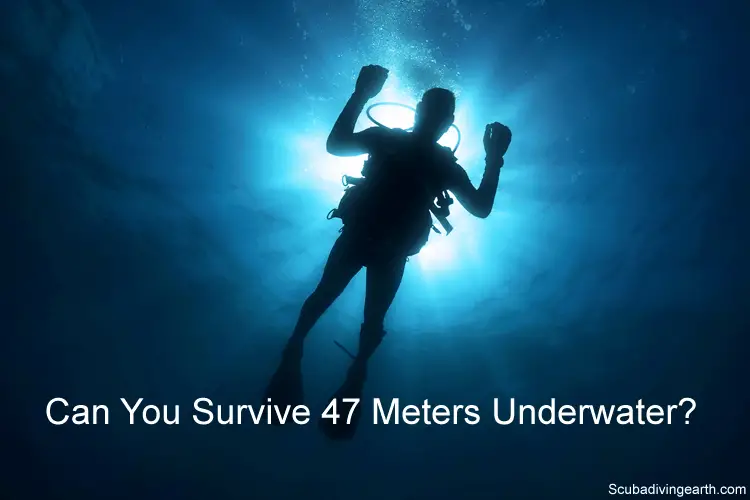
47 metres (154 feet) is considered a deep swoop and only to be dived by experienced scuba divers
47 Metres Downwardly is a fantasy movie about 2 sisters who end upwards 47 metres downwards with great white sharks. Equally a result of this scuba diving moving picture, people ask: " Can you survive 47 meters underwater "
If yous are researching the answer to this question considering y'all would similar to scuba dive, it'southward important to sympathize about surviving 47 metres underwater. You can you survive 47 metres underwater just to do then y'all need to have the necessary training and feel as a scuba diver. To survive a deep dive to 47 metres downward y'all must follow decompression stop limits or carry out decompression stops on your ascent to avert getting decompression sickness.
The best mode to exercise more diving is to book yourself on a scuba diving liveaboard. You can check the latest and best deals on liveaboards using Liveaboard.com beneath, which opens in a new window:

As an aside, in this article about where to find great white sharks, you may exist as surprised equally I was to discover some of the places where you notice slap-up white sharks! Place number 6 is the one that surprised me the most, only if you live in u.s.a., you may be more than surprised at places two, iii and four.
How deep is 47 metres in anxiety?
- A depth of 47 metres in feet is 154 feet.
- A dive of 47 metres in yards is 51.iv yards.
- Diving to 47 metres in miles is 0.0292044 miles.
- A depth of 47 metres in kilometres is 0.047 kilometres.
Please don't get out before you lot watch the video in this article! Before you leave after you've got your reply nigh 47 metres down, you may similar to sentry the video on this article too. I almost don't desire to spoil the terminate of the video, so all I will say is it involves a carcass, many sharks and a single grouper…you may be surprised at what happens, I certainly was!
7 metres or 154 feet deep is the equivalent of the following:
- The length of 2.6 of the longest recorded whale sharks (record whale shark is 18 metres or 33 feet).
- 7.7 of the longest recorded great white sharks stacked head to tail (Longest recorded is 6 metres or 20 feet).
- 7.seven giraffes piled on meridian of each other (tallest giraffe is half-dozen.1 metres (20 feet tall).
- 10 metres (30 feet) taller than the Leaning Belfry of Pisa , which is 57 metres (187 feet).
- v metres deeper than Tower Bridge, London is alpine, which is 42 metres (138 anxiety) loftier.
- The aforementioned height equally the Eschenheimer Tower in Frankfurt, Deutschland which is exactly 47 metres (154 feet) alpine.
How far is 47 metres underwater?
47metres underwater is 154 feet or 51.4 yards and the equivalent of 0.0292044 miles. It would take y'all 42 seconds to walk this far walking at 2.5 miles per hour.
But how far is 47 metres underwater when compared to everyday items?
- 3.xiii times the boilerplate length of a Great britain garden which is xv metres (49 feet).
- ane.5 times the average length of a US garden, which is 104 feet (32 metres) and equates to 10,871 square feet
- Only under the length of an Olympic swimming pool, which is 50 metres (164 feet).
- Similar to the width of an American football game pitch which is 53 1/iii yards wide (48.8 metres; 160 feet).
- Just nether one-half the length of a football field, which are 100 metres (328 feet) long.
How long can you swoop for at 47 metres?
You tin can dive for 8 minutes as a no decompression stop dive to 47 metres downwardly using BSAC tables. PADI swoop tables take a maximum depth of 140 feet (42.6 metres) which gives a no-stop swoop time of 8 minutes.
Is 47 meters down a true story?
47 Metres Down is not based on a true story and the same is true of its sequel 47 Metres Down: Uncaged . If y'all watch 47 Metres Down as a scuba diver you lot will know how ridiculous the moving picture is, only fifty-fifty the author Johannes Roberts refers to some movies equally preposterous.
Roberts puts it similar this: " For me what works about both movies is that they're really, equally preposterous as they are, y'all know, they're movies ".
He goes on to say in an interview with Roberts, " There was a wonderful three-page thesis someone wrote on the get-go movie about the inaccuracies of the diving stuff. And yeah, sure! Only you lot know, if you went downwardly 47 meters in a cage to the bottom of the sea, with a tank, and you lot were an inexperienced diver, y'all would probably last about three minutes earlier you died or ran out of air ."
Have yous heard about the 'Scuba Diving Lizard'? Accept a read of this article about a lizard that can breathe underwater from a scuba-tank like bubble…I was fascinated when I read this!
More about the pic 47 Metres Down?
The pic 47 Metres Down has came in for major criticism from scuba divers for the mistakes in the dive scene. The criticism is around how realistic the underwater scene is. How true is the story or not?
The underwater scene when Mandy Moore (Lisa) and Claire Holt (Kate) sink to 47 metres down is certainly not realistic. The underwater sequence lasts for nearly an 60 minutes.
A swoop time at 47 metres would probably crave much more air than the swoop tank they went downward with. Even with the second tank that was sent downward this would even so not be plenty air to final for threescore minutes at 47 metres. Run into below why scuba diving at depth requires more air. But in the explanation below this assumes a 'gentle' relaxed dive, without much strenuous exercise.
In the picture show 47 Metres Down , Lisa and Kate are far from relaxed and they are also put through their paces besides. This meant they would exist 'drinking' their air supply very very rapidly.
More than Reading: Is it dangerous to scuba dive?
Yous also see below how 28 minutes at 47 metres requires a full of 21 minutes of decompression cease time. But in the picture the bottom fourth dimension is almost double this time. The decompression terminate time would more than double the cease time of a 28 minute dive.
In the motion picture 47 Metres Downwardly Lisa is told to practise a deco stop for 5 minutes at xx metres (67 feet). With such a short decompression stop for such a long dive at 47 metres she would definitely get decompression sickness.
With the length of swoop and resulting amount of nitrogen build-upward she would accept suffered from severe decompression sickness (or the bends). If she wasn't taken to a hyperbaric chamber she may take fifty-fifty died.
I'm lamentable to spoil the picture for those of yous who enjoyed it. As long as y'all apply real escapism to the moving picture, then who cares about the true facts of scuba diving to depth?
More Reading: How deep can yous swoop without decompression – with decompression cease limits
Trailer to the movie 47 metres down
How realistic is 47 meters downwardly?
The movie 47 Meters Down is completely unrealistic. This includes how much air is consumed in hr at 47 metres; how fast Lisa ascends to the surface is unrealistic with but v minutes decompression stop fourth dimension immune.
Please read on to discover the alternative ending to the movie 47 Metres Down.
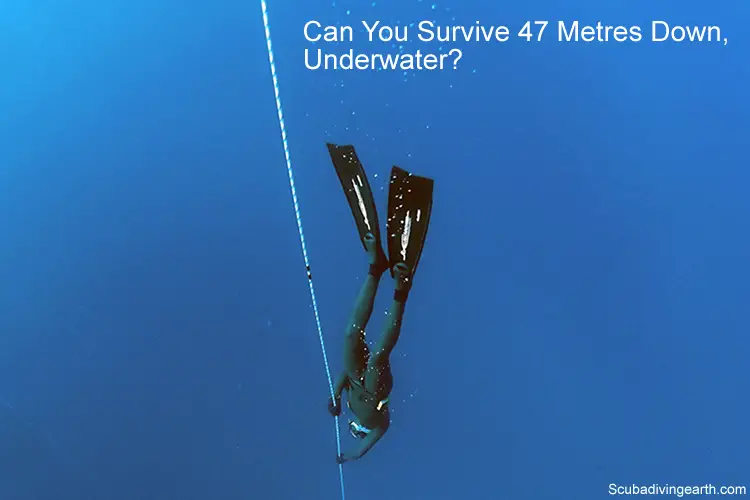
Tin you survive 47 metres underwater?
Scuba divers tin can survive 47 metres underwater, merely unless you restrict your dive time to 9 minutes your dive will plow into a no-stop decompression swoop pregnant you must stop to decompress on your rising. hr at 47 metres would accept several hours to surface safely with long decompression stops.
Diving to 47 metres is 7 metres beyond the PADI recreational diver limit of 40 metres.
Scuba diving to 47 metres (154 feet, 51.four yards) is considered a deep dive.
Read More: Deep diving explained plus 26 tips for deep scuba diving
I've dived to 47 metres (154 feet, 51.4 yards) on many occasions and deeper. This means a dive to 47 metres carries more than risks. See below for the risks associated with scuba diving to 47 metres and deeper.
All scuba diving conduct an element of risk, just the risks and the dangers of diving can exist minimised. Whatsoever dive deeper than 30 metres (100 feet) is a dive just to be considered by an experienced and well trained scuba diver.
PADI limit normal recreational scuba diving to 30 metres (100 feet). Just PADI increment this depth limit to xl metres (130 feet) if you take their 'Deep Diver' course.
This means a scuba dive to 47 metres (154 anxiety) with PADI is non an selection.
Please don't leave earlier you watch the video in this article! So before y'all, you may like to watch the video on this article too. I almost don't want to spoil the cease of the video, so all I will say is it involves a carcass, many sharks and a unmarried grouper…you may exist surprised at what happens, I certainly was!
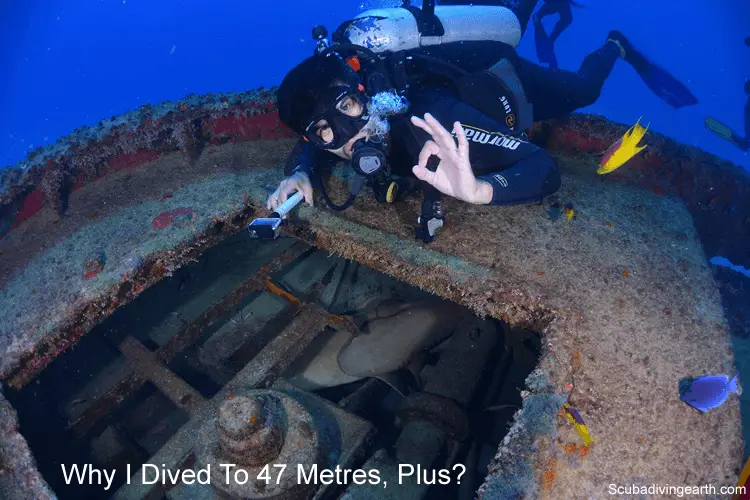
Why I dived to 47 metres, plus?
So y'all may now be asking 'how is it that yous've dived to 47 metres plus?
I certified as a scuba diver with BSAC and not PADI. My BSAC Dive Leader certification permits me to swoop safely to 50 metres (164 feet).
In my scuba diving career I've dived many 40+ metre (130+ feet) dives. But with this type of diving comes with more risk.
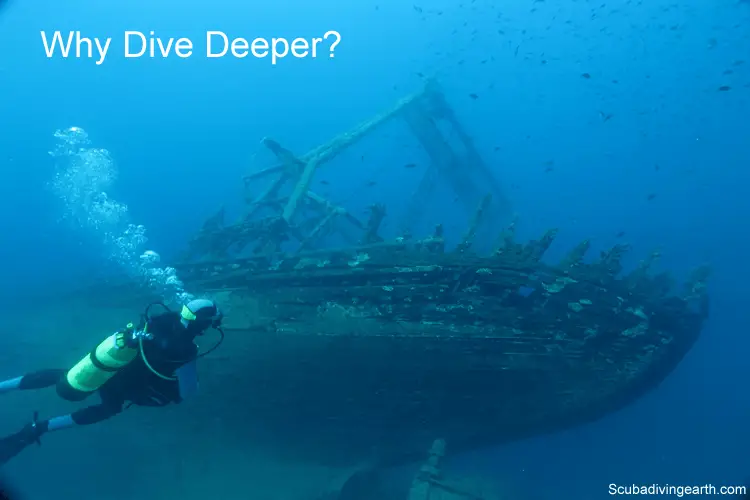
Why dive deeper and why dive to 47 metres?
Any dive should accept a purpose. The same goes for diving deeper every bit there should be a purpose for the swoop. Diving deep but for the 'bragging rights,' is a fools game.
So what might in that location be at 47 metres downwards? In the Uk there are a huge number of wrecks to swoop. These wrecks are every bit a upshot of two world wars and the UK are a aircraft country.
With that there are a huge number of ships that either sank due to bad weather or were sunk in battle during 1 of the globe wars.
More than Reading: Truk Lagoon deep wrecks sunk during World State of war Two
The problem is, when a ship sinks, the wreck sinks where it is in the bounding main. That might exist at 10 metres (30 anxiety), or it may be at 47 metres (154 feet). If the wreck concerned is of interest and it happens to be at 47 metres, then information technology gets dived at that depth in the Great britain.
This same concept applies in other parts of the world too. In that location are many great ship wrecks at depths that scuba divers visit. Some of which are across PADI's recreational limit of 30 or forty metres.
If you are already a scuba diver and would like to swoop deeper, you may need to modify diving arrangement. This is especially true if you learnt to scuba swoop with PADI.
If you lot need reassurance almost scuba diving, let's have a look at the risks that are specifically associated with deeper diving. Just also I will include ways to mitigate those risks.
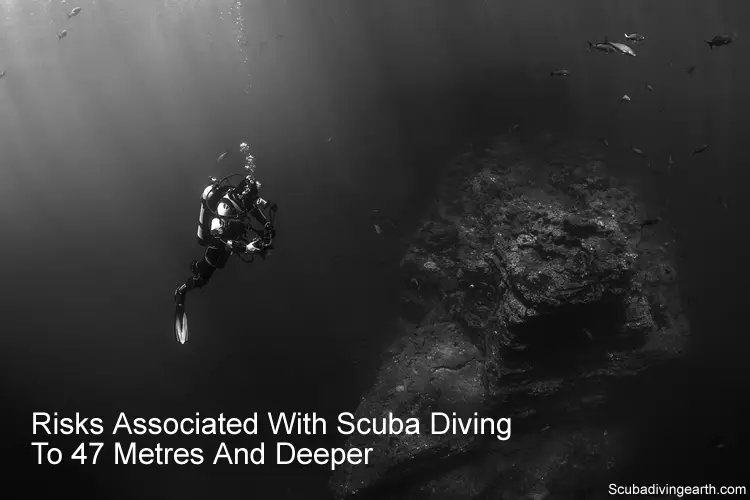
Risks associated with scuba diving to 47 metres and deeper
Deep diving is relatively safe as long as you follow all the rules and procedures. But I idea it all-time to cover the risks associated with diving to 47 metres.
Run a risk #one of diving to 47 metres underwater – risk of running out of air
The first risk associated with diving to 47 metres is running out of air.
The deeper you dive the greater the water pressure level. With this increased pressure air gets compressed. So the deeper you lot go the more your air will get compressed, which is Boyle's Law.
Your lungs are air sacks which require more air to fill them at depth than at body of water level. For example, your lungs crave twice the volume of air to fill them at x metres than at sea level.
As a result y'all exhale more air the deeper you lot dive. Then you will go through your 200 bar (2,900 PSI) air tank much quicker at 47 metres (154 feet) than yous would at x metres (xxx feet) or less.
In essence: The deeper you dive, the less time y'all accept to dive with the same amount of air in your swoop tank.
The take chances therefore at 47 metres is of running our of your air.
How to minimise the risk of running out of air
To minimise this risk of running out of air at 47 metres make sure yous check your air contents approximate more regularly. Merely having said that I propose this is not too dissimilar to diving at any depth. Simply as your air will be consumed faster at depth, you are advised to keep a more focused check on it.
You lot should read this commodity about the top 10 pro safe tips for scuba diving. But cheque the section on how often to cheque your air contents judge.
You must likewise make sure you have plenty air to get yous back to the surface. Which will require more than air from a depth of 47 metres than it would be from thirty metres.
Just you also need to have account of decompression stops too where relevant. Run across below.
More Reading: 28 tips to conserve air when scuba diving
Risk #2 of diving to 47 metres underwater – risk of nitrogen narcosis
The 2d risk of diving to 47 metres or similar depth is nitrogen narcosis. The adventure of nitrogen narcosis increases the further you lot dive below 30 metres (100 feet).
At sea level and on land yous are subject to what's known equally 'one temper' of pressure. This is known equally atmospheric force per unit area (one bar). This pressure amounts to a weight of ten,000 kg thou–2, or 14.seven pounds per foursquare inch.
More than Reading: What are the advantages of diving with Nitrox
Sea water is 800 times more than dumbo than air
Bounding main h2o is approximately 800 times more dense than air at bounding main level. This means that underwater force per unit area increases past one atmosphere for every 10 metres of descent below the surface. For example, at ten metres (100 feet), the pressure is now two bar or 2 atmospheres.
If you lot swoop to 47 metres down (154 feet), which is roughly 50 metres (164 feet), the pressure would be 6 bar or six atmospheres . This is vi times the pressure of the pressure on state.
This results in a higher concentration of nitrogen at depth than it is at the surface. Which at 47 metres this is roughly six times the concentration.
Nitrogen represents about 78% of air. Nitrogen breathed at atmospheric pressure has no result on united states as it'south an inert gas.
However, as y'all become deeper this changes and nitrogen becomes intoxicating. The effects are similar to nitrous oxide inhalation.
This progresses from euphoria to drunkenness to confusion and sometimes to unconsciousness. However in some scuba divers dysphoria (a land of unease) and paranoia occurs. This can lead to panic with some scuba defined.
I accept suffered from a bad dose of nitrogen narcosis, which funnily plenty was at around 47-48 metres. To find out more, delight read this article nearly how to overcome panic when scuba diving.
The adventure of diving to 47 metres is therefore suffering from nitrogen narcosis or the narks.
How to minimise the risk of nitrogen narcosis
The first and simplest way to avoid nitrogen narcosis is to limit your scuba diving to no more than 30 metres (100 feet).
This is actually what I have done. I rarely dive deeper than about 25 metres these days. I no longer swoop on deep wrecks to l metres or so. That'due south non to say that you can't or shouldn't swoop deeper.
The second way to minimise this risk is to build upward your dives. Don't dive directly to 47 metres or whatever depth information technology is y'all are planning to swoop beneath 30 metres.
Past slowly building upwards the depth of your dives during a season, you build upward a bit of a resistance to the effects of nitrogen on your torso. However, this isn't a guarantee, equally was shown by what happened to me.
Consider using nitrox, which has a higher percentage of oxygen in your air. Simply with a 32% mix of oxygen you are limited to a depth of 37 metres (121 feet). Y'all volition need to accept more training for diving using nitrox.
Alternatively, you use mixed gases. Using mixed gases at depth changes the limerick of the air you are animate. This is technical diving, which is a type of diving that I've non done myself. So I won't explain this anymore in this article.
Nevertheless, having said that the technical defined will probably say; using trimix gas at 47 metres would be wasted as it'south expensive.
Hazard #3 of diving to 47 metres underwater – Decompression sickness
The next risk that's associated with diving deeper is the risk of decompression sickness or DCS.
Decompression sickness is acquired by a scuba diver coming upwards also fast from a dive. The crusade of decompression sickness is equally a consequence of the dissolved nitrogen being released too quickly from your body'due south tissues on ascent.
This released nitrogen forms bubbles. It'due south these bubbles that can cause major problems. These bug can be as minimal equally a skin rash or a skin curve, to the extreme of a fatality.
The deeper you become the faster and the more nitrogen dissolves into your trunk. Once the amount of nitrogen dissolved in your tissues goes past a sure limit the dive becomes a decompression finish swoop. Which means you must stop on your rising to increase your decompression time.
However, if you want to limit your swoop to a no decompression end dive, you need to limit your bottom time accordingly. For instance, at a depth of 47 metres diving on the BSAC Table A you accept a total of 9 minutes no decompression end time at this depth.
If you exceed your no-stop bottom time yous accept to do decompression stops on your ascent
If you exceed the no-stop swoop time, you autumn into what's known as a decompression stop dive. This means that in addition to using your ascent from your dive as decompression time, you volition also need to contain certain decompression stops too.
For example, if your swoop time at 47 metres went to 28 minutes, this would involve two decompression stops. One at ix metres (30 feet) for three minutes and a 2d decompression stop at 6 metres (20 feet) for 18 minutes.
The important thing to annotation is that you not just need enough air to complete your bottom time of 28 minutes, bearing in mind your increased air consumption due to the depth of the dive, plus you'll need enough air to become to both decompression stops and to deport out the stops.
On top of that y'all then need to go far at the surface with your reserve air, which is generally accepted as 50 bar (725 psi).
The chance is therefore decompression sickness due to non decompressing properly on your return to the surface. The risk of which is increased due to how quickly decompression time sets in at these deeper depths.
For case, I remember getting towards the time to ascend from a 50 metres dive (164 feet), and at the time we had over xx minutes of deco fourth dimension. But for some reason I couldn't release my delayed surface marker beacon.
More Reading: What is a surface mark buoy used for? (Safe diving equipment)
The filibuster was simply a minute or so but this added a significant amount of time to our decompression stops. At depth things tin get wrong quickly. So be prepared and don't swoop tired and be cautious.
How to minimise the gamble of decompression sickness
The easy manner to avoid decompression sickness is to follow the correct rising rules of scuba diving. You lot must not arise too quickly for a outset. But y'all must also behave out decompression stops when necessary. Furthermore use a dive estimator to calculate bottom times, ascent rates and decompression stop times.
To reduce the run a risk further, y'all are better to only dive no cease decompression dives. However, this will limit the amount of fourth dimension you have on the bottom.
At that place's non much you lot can do or see on a wreck in nine minutes. This is especially truthful if it's a particularly large wreck.
More Reading: Is scuba diving more dangerous than skydiving?
47 Meters Downwardly movie alternative ending
The moving-picture show 47 Metres Downward, might have had an alternating ending. But the alternate catastrophe might not be Hollywood at its all-time or at their virtually exciting.
The alternative ending might be that sisters Kate and Lisa:
- Carefully programme their rising from 47 metres downward
- They would carefully checking their total bottom time.
- Their dive planning would include a dive computer.
- With a correctly calculated lesser fourth dimension and carefully planned deco-stops, they would ascend slowly to the surface.
- On their manner to the surface they would stop at the diverse decompression stops, for the correct amount of time.
This alternative catastrophe to 47 Metres Downwards may please the scientists and the die-hard scuba defined who empathise decompression and decompression stops. But for those who only want to enjoy a thriller or a horror movie, it probably doesn't actually thing.
For pure escapism it's sometimes okay to stretch the premises of science.
The final step in the 'less-heady' 47 metres down alternate ending would be for Kate and Lisa to conduct out a safety stop for three minutes at 5-6 metres (xvi-20 feet).
Condom stops are precautionary stops scuba divers exercise for safety. But for Hollywood actors and a in motion-picture show where the characters are escaping from sharks, safety stops are not likely!
I hope this article doesn't spoil your fun of watching the picture show. But if you lot're genuinely researching the concept of scuba diving to 47 metres for the purpose of being rubber when diving, then I hope this article has helped.
More reading: Is information technology dangerous to scuba dive with sharks?
Don't forget to take a look at this article about where to discover slap-up white sharks, y'all may exist as surprised equally I was to discover some of the places where you find corking white sharks! Place number vi is the 1 that surprised me the most, just if you live in usa, you may exist more surprised at places 2, three and four.
I hope you enjoyed this article about can you survive 47 meters underwater
I'd love to hear from you. Tell u.s. about your adventures of diving and snorkeling, in the comments below. Delight besides share your photos. Either from your underwater cameras or videos from your waterproof Gopro's!
If this article hasn't answered all of your questions. If you have more questions either about snorkeling or types of scuba diving (or specifically about can you lot survive 47 meters underwater), please comment below with your questions.
In that location volition likewise exist many more than articles virtually scuba diving (and snorkeling) for you lot to read and acquire virtually these fabulous sports.
Have fun and be safe!
Russell Bowyer

Article written past Russell Bowyer who has been a scuba diver since diving on the Great Barrier Reef in Commonwealth of australia in 1989. After his beginning dive he trained equally a BSAC diver in the UK. He attained his Diver Leader certification with BSAC. He and so went on to get a scuba diving teacher, education others how to dive and was voted as Diving Officeholder and Treasurer for the Saffron Walden BSAC club likewise. Russell has dived all over the world, including the UK, on liveaboards in the Red Sea, the Caribbean area, Southward Africa and the USA. Russell is experienced in all dive types, including drift diving, deep dives that involved decompression stops and recreational dives too.

How Far Is 47 M,
Source: https://www.scubadivingearth.com/can-you-survive-47-meters-underwater/
Posted by: laraobeft1996.blogspot.com
0 Response to "How Far Is 47 M"
Post a Comment